§ 01
Overview
Module 1.1: The ACL Landscape
§ 01
What Are the Academies of Loudoun?
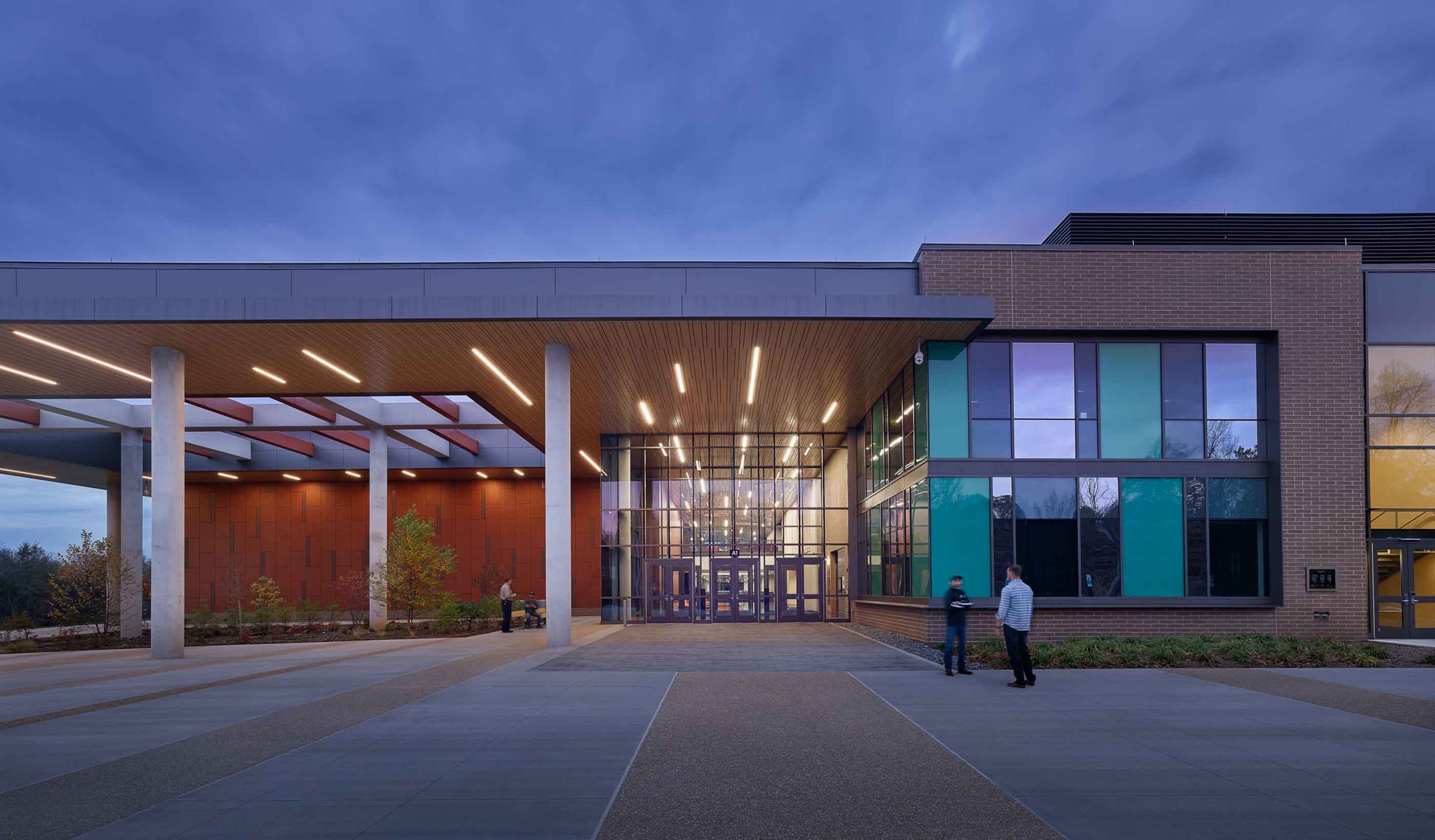
The Academies of Loudoun (ACL) is a selective STEM magnet campus run by Loudoun County Public Schools (LCPS). It's located at 42075 Loudoun Academy Drive in Leesburg, Virginia, on a 119-acre wooded campus that cost roughly $125 million to build.
Here's the first thing to understand: ACL is not one school. It's a campus that houses three separate programs, each with its own mission, its own curriculum, and its own admissions process.
-
AOS (Academy of Science) --- Research-intensive STEM. Students dive deep into advanced math, science, and independent research.
-
AET (Academy of Engineering and Technology) --- Applied STEM. Students choose between engineering, information technology/computer science, or entrepreneurship.
-
MATA (Monroe Advanced Technical Academy) --- Career and Technical Education (CTE). Students pick from 26 career pathways spanning health sciences, skilled trades, IT, culinary arts, and more.
All three programs share the same physical campus, but they operate as separate schools with separate admissions, separate curricula, and separate student bodies.
One important rule: Students may only participate in ONE ACL program at a time. If a student wants to switch programs, they must fully withdraw from their current program and re-apply during the Winter admissions cycle. There is no internal transfer process.
§ 02
How the Three Programs Differ
Academy of Science (AOS)
AOS is the most selective of the three programs. It's built for students who want to go deep into research-driven STEM. The curriculum weaves together advanced math and science across all four years, and in Years 3 and 4, students take on independent research projects --- original work in real labs, not just classroom assignments.
AOS students don't follow the standard LCPS course sequence. Instead, they take specialized integrated math and science courses unique to the AOS program, with AP-level content built right into the curriculum. These integrated courses carry a 0.5 (Honors) or 1.0 (AP) GPA weight, calculated into the student's home-school GPA.
People often compare AOS to TJHSST (Thomas Jefferson High School for Science and Technology), and the comparison makes sense --- both programs center on scientific research. The big structural difference is that AOS students split their time between the Academies campus and their home high school, while TJ students attend TJ full time.
Best for: Students who are genuinely passionate about scientific research, lab work, and deep academic inquiry in math and science.
Academy of Engineering and Technology (AET)
AET gives students three tracks to choose from:
-
Engineering --- Hands-on design, prototyping, and engineering problem-solving
-
Information Technology / Computer Science --- Programming, cybersecurity, data science, and systems design
-
Entrepreneurship --- Business development, innovation, and where technology meets commerce
Like AOS, AET has its own integrated math and science courses. But the emphasis here is on applied problem-solving --- building things, writing code, designing systems --- rather than pure research. Students work on engineering design projects and develop real technical skills in their chosen track.
Best for: Students who want to build, design, code, or launch ventures. If you're drawn to the practical side of STEM --- making things work, not just studying how they work --- AET is worth a close look.
Monroe Advanced Technical Academy (MATA)
MATA holds a Governor's STEM Academy designation from the Virginia Department of Education, which recognizes programs delivering serious career and technical education in STEM fields. It offers 26 career pathway options organized across career clusters, including:
-
Health sciences (certified nurse aide, pharmacy technician, biotechnology)
-
Information technology (cybersecurity, networking)
-
Skilled trades (welding, automotive technology, construction)
-
Culinary arts
-
And many more
MATA's mission is fundamentally different from AOS and AET. While those programs are geared toward competitive university admissions and research careers, MATA is designed to prepare students for both college and direct workforce entry. Students can earn industry-recognized certifications and get hands-on career training while still in high school.
Important eligibility note for 8th graders: 8th graders applying to MATA are only eligible for one pathway: Introduction to Health and Medical Sciences. All other 25 pathways are restricted to 10th and 11th grade applicants.
Best for: Students who know what career field they want to pursue and want real-world training, certifications, and a clear pathway --- whether that leads to college, an apprenticeship, or straight into the workforce.
§ 03
The Alternating Day Schedule
This is one of the most important things to understand about ACL, and it catches a lot of families off guard: students do not attend the Academies campus full time.
ACL uses an alternating day schedule (sometimes called an A/B schedule):
-
On "A" days, students go to the Academies of Loudoun campus in Leesburg for their STEM or CTE coursework.
-
On "B" days, students go to their regular home high school (whichever school they're zoned for based on where they live) for the rest of their classes --- English, social studies, electives, and so on.
This means every ACL student is dual-enrolled. They're a student at their home high school and a student at the Academies at the same time.
What this looks like day to day:
Transportation --- LCPS provides bus transportation between home high schools and the ACL campus on Academy days. Families don't need to arrange rides.
Extracurriculars --- Students play sports, join clubs, and do activities at their home high school, not at ACL. This is a big difference from TJHSST, where students do everything at TJ.
Social life --- Students keep their friendships and social connections at their home school while also building a second peer group at the Academies. Most families see this as a positive --- students get the best of both worlds.
Scheduling --- Coordinating courses across two schools takes some planning. Guidance counselors at both the home school and ACL work together to make sure schedules line up.
Graduation --- Students graduate from their home high school, not from the Academies. The diploma comes from the home school, with Academies coursework reflected on the transcript.
§ 04
How ACL Compares to Other Regional STEM Programs
Families in Loudoun County have access to several specialized programs beyond ACL. It's worth understanding how they all fit together so you can make the best decision for your student.
TJHSST (Thomas Jefferson High School for Science and Technology)
TJ is a full-time magnet school in Alexandria, Virginia. Students attend TJ all day, every day --- there's no alternating schedule. TJ draws from multiple counties and cities (Fairfax, Loudoun, Prince William, and Arlington counties, plus the cities of Fairfax and Falls Church), making the applicant pool much larger.
TJ no longer uses a traditional admissions test --- in 2020, it switched to a holistic review process that evaluates GPA, a problem-solving essay, a student portrait sheet, and experience factors. The problem-solving essay is administered in January of 8th grade, while the ACL STEM Thinking Skills Assessment happens earlier --- typically October or November of 8th grade. The evaluation methods are fundamentally different in format and content.
For Loudoun families, the biggest practical difference is the commute. TJ is in Alexandria, which can mean 60+ minutes each way for many Loudoun students. ACL is in Leesburg, generally 15-30 minutes from most Loudoun locations.
Students graduate with a TJ diploma and participate in TJ's own extracurricular programs --- unlike ACL, where students stay connected to their home school.
One important note: the admissions timelines for TJ and ACL don't conflict, so students can (and many do) apply to both in the same year.
IB (International Baccalaureate) Programs
Two LCPS high schools --- Heritage High School and Loudoun Valley High School --- offer the IB Diploma Programme, a rigorous, internationally recognized two-year curriculum for grades 11-12, with pre-IB coursework in grades 9-10. IB covers six subject groups --- languages, humanities, sciences, math, the arts, and electives. It's a broad academic program, not a STEM-specific one.
The key difference: IB gives students academic rigor across all disciplines, while ACL zeroes in on STEM. If your student wants a well-rounded honors curriculum rather than a STEM specialization, IB might be the better fit.
ACCESS Academy
ACCESS launched in the 2025-2026 school year as a lab school partnership between LCPS, George Mason University, and Northern Virginia Community College (NOVA). It focuses specifically on information technology and career-ready skills.
Students attend Potomac Falls High School for grades 9-10, then move to George Mason's Fuse at Mason Square for grades 11-12. The program holds about 120 students total (30 per grade) and uses a lottery for admissions --- no entrance exam required. As a lab school, ACCESS is open to all Virginia students, not just those in LCPS. It's a four-year commitment, and students don't need to reapply each year.
The key difference: ACCESS is narrower than AET (IT only, versus AET's three tracks), uses a lottery instead of merit-based admissions, and is a full-time program --- students don't go back to a home school on alternating days.
HAMSci (Health and Medical Sciences Career Institute)
HAMSci is a four-year health sciences program hosted at Briar Woods High School and Tuscarora High School. Students choose between two pathways:
-
Biomedical Sciences --- four full years of specialized biomedical science courses
-
Biomedical Sciences + Language of Medicine --- two years of biomedical sciences followed by two years of medical terminology and health systems
The key difference: unlike ACL, HAMSci students transfer full-time to the host school. They become regular students at Briar Woods or Tuscarora, participate in that school's sports and clubs, and graduate from there. HAMSci was created partly because MATA's health science pathway was bursting at the seams --- in 2022-2023, it had 304 students enrolled with nearly 300 more on the waitlist.
AGLS (Academy of Global and Linguistic Studies)
AGLS is a humanities-focused academy at Dominion High School, launching in the 2026-2027 school year. It's built around global leadership, diplomacy, business, and world languages. It offers two career paths:
-
Leadership pathway --- centered on Arabic language study
-
Business pathway --- centered on Mandarin language study
At full capacity (expected by 2030-2031), the program will hold about 400 students across four grade levels (100 per grade, 50 per pathway), and admissions are lottery-based.
The key difference: AGLS is not a STEM program at all. It's for students interested in diplomacy, international relations, and global business --- a completely different direction from ACL.
§ 05
Quick Comparison
-
AOS --- Research science, alternating day schedule, merit-based admissions (test + writing + grades), STEM-focused
-
AET --- Engineering / IT / Entrepreneurship, alternating day schedule, merit-based admissions, STEM-focused
-
MATA --- Career and technical education, alternating day schedule, application, CTE/STEM
-
TJHSST --- Research science and technology, full-time magnet, holistic review admissions (GPA + essay + portrait sheet + experience factors), STEM-focused
-
IB --- Broad academic excellence, full-time at IB school, varies by school, all subjects (not STEM-specific)
-
ACCESS --- Information technology, full-time (two campuses), lottery-based, IT-focused
-
HAMSci --- Health and medical sciences, full-time transfer, lottery-based, health/STEM
-
AGLS --- Global leadership and languages, full-time at Dominion HS, lottery-based, humanities (not STEM)
§ 06
Acceptance Rates and Cohort Sizes
LCPS doesn't publish detailed annual admissions statistics for each ACL program, which can be frustrating for families trying to gauge their chances. That said, here's what we know from school board documents, school profiles, and public reporting.
AOS (Academy of Science)
AOS is one of the most selective public school programs in Virginia. The acceptance rate has ranged from roughly 4% to 8% depending on the year. The most recent figures suggest it's around 4.3% (as of the 2025 cycle). To put that in perspective, in 2020, approximately 1,461 students applied and 119 were admitted --- about an 8% acceptance rate. The trend has gotten more competitive since then.
Based on historical data, AOS typically admits somewhere around 100 to 150 students per incoming class, though the exact number shifts year to year.
AET (Academy of Engineering and Technology)
AET is competitive, but generally less selective than AOS. LCPS doesn't consistently publish exact acceptance rates for AET. The incoming cohort is larger than AOS each year, which makes sense given that AET has three separate tracks (Engineering, IT/CS, Entrepreneurship) to fill.
MATA (Monroe Advanced Technical Academy)
MATA has historically been less selective than AOS or AET overall, but that doesn't mean every pathway is easy to get into. Certain high-demand pathways --- especially health sciences --- have had massive waitlists. In 2022-2023, the health sciences pathway alone had 304 students enrolled and nearly 300 more waiting for a spot.
MATA enrolls the largest number of students across the ACL campus, given its 26 pathway options.
Total ACL Enrollment
The 2023-2024 ACL School Profile reported a total enrollment of 2,171 students across all three programs and all four grade levels:
-
9th grade: 300 students
-
10th grade: 316 students
-
11th grade: 748 students
-
12th grade: 807 students
-
Total: 2,171 students
You'll notice enrollment jumps significantly in 11th and 12th grade. That's because MATA students can enter in later years, and the Advanced AET pathway allows current high school students to join AET after 9th grade.
§ 07
The \"Blind Admissions\" Process
Since 2020, ACL has used a blind admissions process for AOS and AET. Here's what that means in practice:
First, all personal identifying information is stripped from applications before anyone reviews them. The people evaluating your application don't know the student's name, home school, race, ethnicity, or any other identifying details.
Second, applications are judged entirely on three things:
-
STEM Thinking Skills Assessment score (a standardized test created by Insight Assessment, scored on a 260-300 scale --- 50 minutes, 33 questions, administered via a secure online platform on LCPS-provided laptops)
-
Writing Assessment score (a 45-minute writing task graded against the ACL Writing Rubric)
-
Academic record (grades and math course enrollment --- Algebra I is the minimum prerequisite)
Third, identifying information only gets reattached after admissions decisions have already been made --- after every application has been sorted into admit, waitlist, or deny.
Why this matters for you: Your application materials have to speak for themselves. There's no interview. There's no in-person impression. No one knows your name. Your STEM Thinking Skills Assessment score, your writing sample, and your grades are literally all the evaluators see. That's why preparation for each of these components is so critical --- and it's exactly what the rest of this course is designed to help with.
§ 08
Key Takeaways
-
ACL is three programs, not one. AOS, AET, and MATA serve different types of students with different interests. Pick the one that genuinely fits --- don't just chase the most "prestigious" option.
-
The alternating day schedule is a defining feature. Unlike TJHSST, ACL students stay connected to their home high school for half their coursework, all their extracurriculars, and their social life.
-
AOS is extremely selective (roughly 4-8% acceptance rate), putting it in the same ballpark as TJHSST. AET is competitive but somewhat less selective. MATA varies a lot by pathway.
-
Blind admissions means your materials are everything. No interview, no name recognition, no school reputation --- just your test scores, writing, and grades.
-
ACL is one option among several. IB, ACCESS, HAMSci, AGLS, TJHSST, and strong AP programs at home high schools are all legitimate paths to college and career success. The best choice depends on the individual student.